The long game
Climate, advocacy, and the system-level forces that will shape the future of travel.



The paradox of travel
We’ve been taking people to places like Kyoto and Hội An for the last 25 years. Our goal is to be doing the same for decades to come.
At its best, travel creates understanding, supports livelihoods and helps protect the heritage that makes these places worth visiting.
But the trips that do this also produce carbon emissions that contribute to climate change. And we are already seeing its effects in the places we travel to.
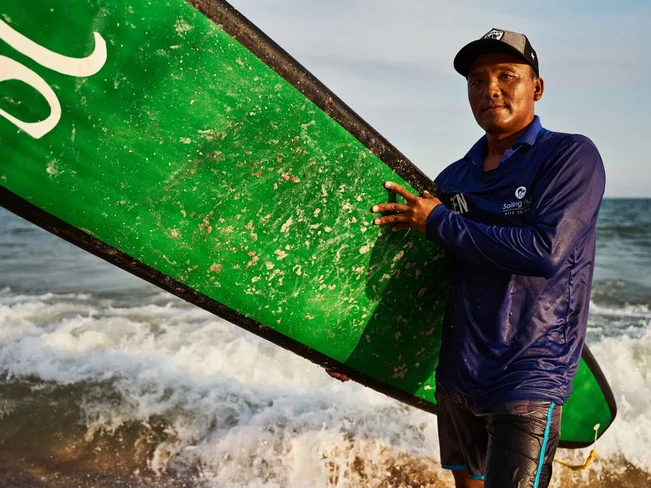
Kyoto, 2025
Summer 2025 was Japan's hottest since records began in 1898, with the national average 2.36°C above the 30-year baseline, while Kyoto reached 40°C for the first time in its local record.
Hội An, 2025
A succession of typhoons and extreme rainfall brought severe flooding across Vietnam in late 2025. Historic areas of Hội An and Huế were submerged, disrupting communities, livelihoods and tourism.

Measure what we cause
We account for the lifecycle emissions associated with our trips, including international flights whether customers book them through us or independently.
Reduce the carbon intensity of each trip
Growth puts upward pressure on total emissions. Our primary operational focus is therefore reducing carbon intensity: the emissions generated per passenger and per night. We continue to measure and report absolute emissions alongside this.
Rethink targets and report transparently
We use intensity targets for the emissions we can influence through trip design, such as flights, accommodation and ground arrangements. We use absolute reduction targets for the emissions we control more directly, such as energy use in our offices.
Invest in long-term climate work beyond our trips
For three years, we offset every trip as standard. It provided accountability, but it did not, on its own, finance the deeper changes needed to reduce emissions across the systems travel depends on. We retired the programme at the end of 2025 to be replaced with a new Impact Fund from 2026.

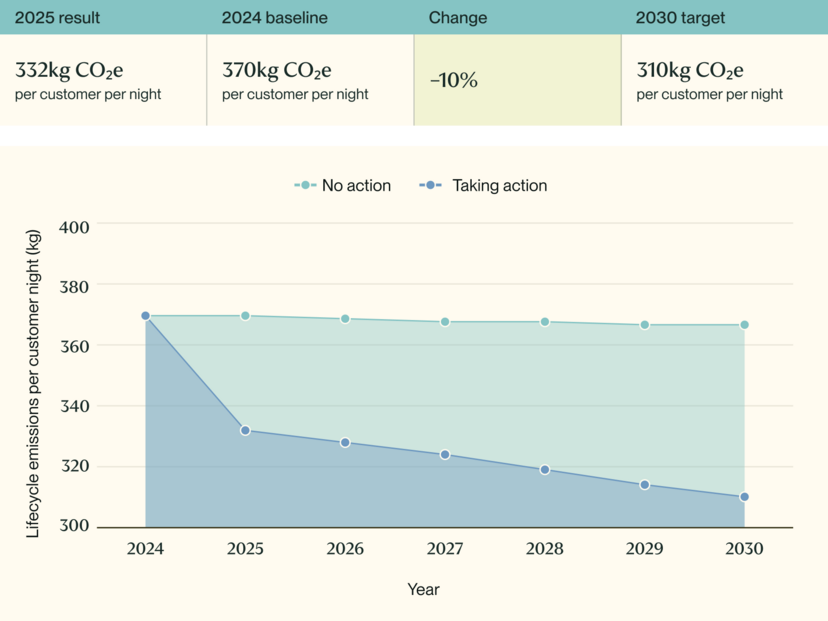
1) Reduce lifecycle carbon intensity by 16% by 2030
Lifecycle carbon intensity is our broadest measure of whether each trip is becoming less carbon-intensive over time.
It reflects the total emissions associated with a trip, including all international flights, ground arrangements, and operational emissions, expressed per passenger per night.
In 2025, lifecycle carbon intensity fell to 332kg CO₂e per customer per night, a 10% reduction against the baseline. This looks like strong progress, but the main driver was a change in emissions methodology rather than a major shift in the actual emissions from our trips. See technical notes below.
Why two headline targets?
We use two types of target because not all emissions sit equally within our control.
For the full footprint of our trips, we track carbon intensity: the total emissions generated per passenger per night. For the emissions most directly linked to running our offices and business operations, we use an absolute reduction target. It also maintains our Glasgow Declaration commitment.
What do we mean by lifecycle intensity?
Lifecycle intensity measures the total emissions associated with a trip, expressed per passenger per night.
It includes international flights whether booked through us or independently, ground arrangements such as transfers and accommodation, and our operational emissions.
It is our broadest measure of whether each trip is becoming less carbon-intensive over time. We use it as our headline metric because it captures the full picture of what a trip produces, not just the parts we book directly.
Why does intensity matter? Why not just measure total emissions?
As a growing business, our total emissions are likely to increase as passenger numbers grow. Tracking carbon intensity allows us to measure efficiency improvements over time, design lower-impact trips as standard, and grow responsibly.
We are also a very asset-light business. We do not own aircraft, transport infrastructure or accommodation. As a result, over 99% of our emissions sit outside our direct control. That reality shapes our strategy: we focus on trip design, partner choice and collective action rather than claiming direct control over systems we do not operate.
We will continue to measure and report absolute emissions transparently alongside intensity metrics.
Why did lifecycle intensity drop by 10% in 2025, and should we trust it?
We were not expecting a drop of this size in year one.
The most significant factor was a change to the way aviation emissions are calculated in UK Government guidance, specifically a revision to the radiative forcing uplift factor applied to aviation from 1.9 to 1.7, rather than a change in the actual emissions from our flights.
This means our reported aviation emissions for the year decreased relative to before. It is a change in estimation assumptions, not in actual flight emissions.
We have updated our 2026 to 2030 forecast to account for this, so we can remain focused on genuine operational improvements and be clear about the impact those have when they come.
Method note: independently booked flights are estimated using route and distance modelling aligned to our trip and customer data, in partnership with ecollective.
How are we planning to hit the 2030 lifecycle intensity target?
Our headline target is a 16% reduction in lifecycle carbon intensity by 2030. That breaks into two areas.
Flight intensity: -26% by 2030
Prioritising direct flights where possible. Economy cabins recommended as standard. Shorter routes where indirect flights are necessary. More bookings with airlines holding credible climate targets. Advocating for policy reform and Sustainable Aviation Fuel (SAF) incentives.
Note: This 26% target has been revised from 16% to account for DEFRA's revision to the radiative forcing uplift factor.
Ground arrangements: -9% by 2030
Transfers shifting to hybrid or electric vehicles. Replacing short domestic flights where feasible. More stays in lower-impact accommodation. Working with major suppliers on emissions. Designing trips for longer stays and slower travel.
What can we actually do about flight emissions as a tour operator?
We do not own aircraft or control how they are operated. But we do influence which flights customers take, how they travel and which airlines we work with. Our Flight Guiding Principles set out how we:
Prioritise direct routes where possible: shorter distances mean lower emissions.
Recommend economy cabins as standard - premium cabins carry a significantly higher emissions cost per passenger.
Choose shorter routes where indirect flights are necessary.
Work with airlines that have credible climate targets.
These choices are built into how we design trips and advise customers.
2) Reduce Scope 1 and 2 emissions by 50% by 2030
Scope 1 and 2 are the emissions most directly linked to running our offices and business operations: direct fuel use from sources we own or control, and purchased energy for our offices.
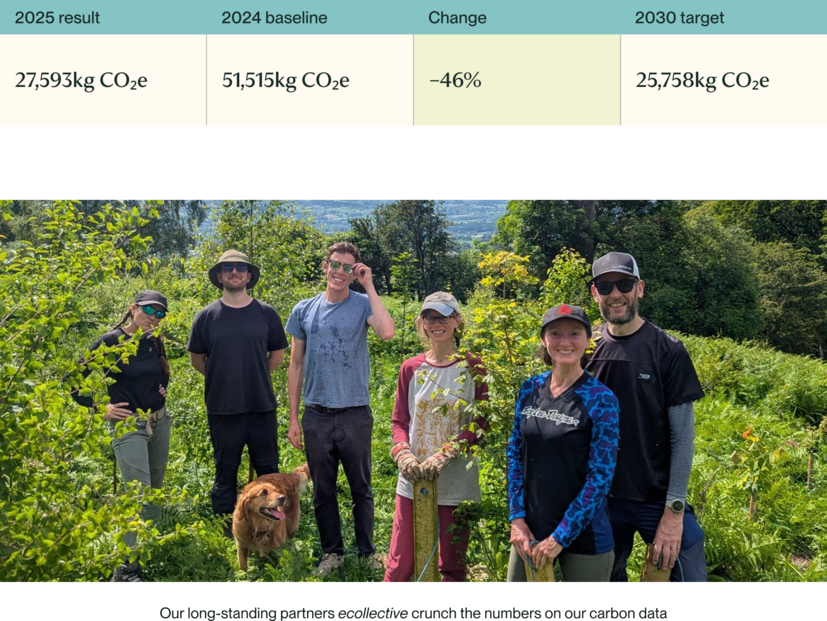
That is why we set an absolute reduction target here, rather than an intensity target linked to customer volume. Our goal is to halve these emissions by 2030, from a 2024 baseline of 51,515kg CO₂e.
In 2025, Scope 1 and 2 emissions fell to 27,593kg CO₂e, a 46% reduction against the baseline. The main driver was our office move in Japan, where we switched to renewable energy. In 2025, 88% of our global office energy use came from renewable sources.

Retiring Every Trip Offset
In 2025, we concluded our Every Trip Offset program: a three-year commitment to offset every trip automatically.
It was extensive. We accounted for all international flights too, regardless of whether the customer booked through us or independently.
Between 2023 and 2025, we offset 197,650 tonnes of carbon dioxide equivalent (tCO₂e).
Clean Power Portfolio
55,755 tCO₂e offset in 2025
Renewable-energy projects across developing economies, including wind, solar and hydropower. Verified under the Clean Development Mechanism and Verified Carbon Standard.
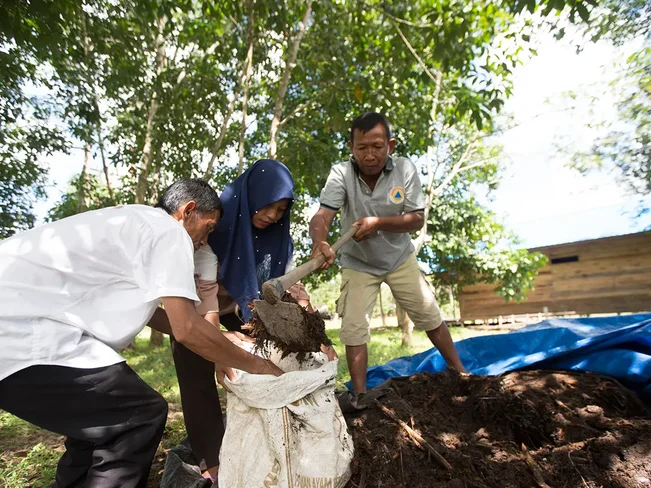
Katingan Peatland Conservation
23,895 tCO₂e offset in 2025
Protection of tropical peatland in Indonesian Borneo from conversion and degradation. Verified under Verified Carbon Standard (VCS), the Climate, Community & Biodiversity Standards and SD VISta.
From compensation to contribution
Retiring Every Trip Offset came from asking a different question.
For three years, the question was: how do we compensate for the footprint of each trip? The question we are now asking is different: what changes does the future of travel need, and where can our funding be most useful in supporting them?
Our Impact Fund
Some changes in travel need funding beyond the individual trip. That could mean restoring ecosystems in our destinations, helping partners reduce emissions, supporting communities or backing wider change across travel and aviation.
The Impact Fund replaces Every Trip Offset. It gives us a way to support longer-term work that individual itineraries cannot.
These investments are not used to claim carbon neutrality or to offset individual trips.

Carbon removal
High-quality projects that remove carbon from the atmosphere.
Aviation decarbonisation
Support for credible efforts to scale Sustainable Aviation Fuel (SAF) and reduce aviation emissions.
Climate innovation
Early-stage climate technologies that could transform decarbonisation in the long term.
Supply chain insetting
Support for selected suppliers to reduce emissions in destination.
Biodiversity projects
Biodiversity restoration and community-led conservation in our core destinations.
Community resilience
Support for community-led projects that strengthen local livelihoods, wellbeing and resilience in places connected with our trips.

Human-bear co-existence
Human-bear encounters across Japan are increasing. Researchers point to climate anomalies alongside growing bear populations and rural depopulation. In much of rural Japan, the default response is culling. Non-lethal capacity is limited, and the pressure on local authorities to act fast, and lethally, is significant.
We support Picchio Wildlife Research Center to develop and scale coexistence methods. In 2025, we helped fund the arrival of Sushana - a Karelian bear dog trained to detect bears early through scent tracking and discourage bears from returning to human settlements without culling.

Her training has mainly consisted of tracking bear scents and becoming accustomed to loud, distracting sounds such as fireworks and people shouting. She has a powerful bark, a strong instinct for following scents, and a calm nature around members of the public – she is fast becoming a prominent ambassador for Picchio's work."
River science in Daisen
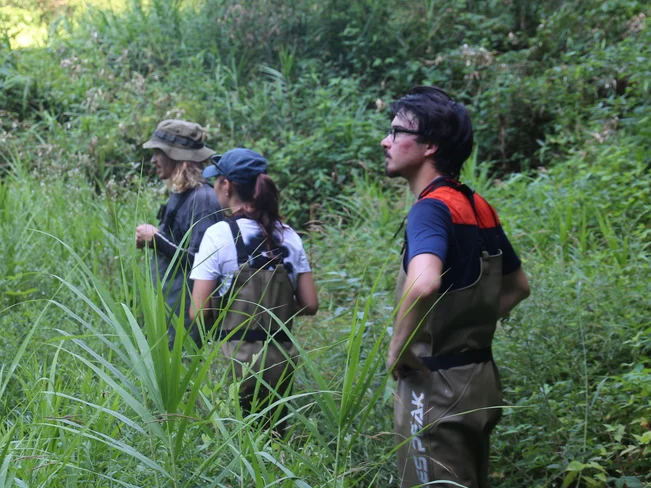
The Daisen river system in Tottori is one of the places where the Japanese Giant Salamander still breeds.
Sustainable Daisen monitors the wider river system the species depends on, including water quality and the weirs and barriers that affect how salamanders move. Led by former InsideJapan tour leader Richard Pearce, the project combines night surveys, water-quality testing and low-impact ecotourism.
In 2025, our support helped fund population monitoring, river-barrier mapping and water testing. Larvae were confirmed in three rivers, and water-quality data helped support local concerns about pollution from an upstream pig farm.


Travel by B Corp
Travel by B Corp brings certified B Corp travel businesses together to "practice, prove and promote travel and tourism that benefits all".
In 2025, the network agreed a clearer model for turning collective ambition into practical work.
- Shared Impact Projects (SHIPs): Small, member-led groups addressing challenges no operator can solve alone.
- A Voice for Change: Using collective weight where individual influence is limited.
- A Learning Community: Sharing evidence, experience and tools rather than solving the same problems separately.

Our Overtourism SHIP
In 2025, the first SHIPs began. We are closely involved in one of them: an industry playbook designed to help travel businesses address overtourism through the way they design, market and sell trips.
Addressing Overtourism: The Marketing Playbook (July 2026)
Working group: Inside Travel, Sawday's, Intrepid, Selective Asia, Experience Travel Group and Kemosabe.

Aviation advocacy
International aviation is the largest part of our footprint and one of the hardest parts to change. Changes made by individual travel companies matter, but they will not be enough without policy, investment and regulation capable of shifting the wider aviation system.
Our advocacy began to take shape in August 2025, when we hosted Kerry McCarthy MP (then Minister for Climate) at our Bristol office. The conversation covered aviation's role at the heart of the paradox of travel, the role and limits of Sustainable Aviation Fuel, and what effective advocacy looks like for us going forward.
Five months later, we followed that conversation to Westminster, where Simon and Dom joined MPs, policy specialists, and industry innovators to discuss the future of UK aviation.

Track flight distance
Introduce a flight-distance tracker to strengthen analysis on shorter routes where indirect flights are necessary.
Establish the Impact Fund
Fully transition from Every Trip Offset to the Impact Fund, with focus areas across carbon removal, aviation decarbonisation, climate innovation, supply chain insetting, biodiversity and community resilience.
Report on the Impact Fund
Publish what the fund supports, why projects were selected, what evidence is available and where results remain uncertain in the 2026 Impact Report.
Transition to hybrid and electric
Extend the hybrid and electric transfer model already running in Japan to Southeast Asia operations.
Publish aviation advocacy positions
Agree and publish clearer positions on aviation policy, including efficiency, Sustainable Aviation Fuel and the conditions needed for credible decarbonisation.
Launch Shared Impact Project
Launch the Travel by B Corp Shared Impact Project on overtourism.